
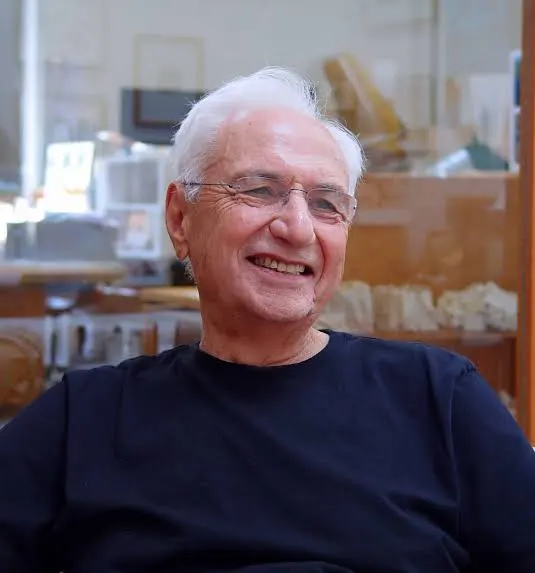
It is difficult to write about Frank Gehry without first confronting the caricature.
For decades, he was reduced to a gesture: the architect who crumples a piece of paper and hands it to his office to “figure it out.” It was an easy image. A seductive myth. It allowed critics to dismiss his work as impulsive spectacle and admirers to romanticize it as pure intuition. But both interpretations miss something essential.
Gehry did not crumble paper. He unfolded possibilities.
He dedicated his life to architecture with a stubborn refusal to follow the path everyone else followed. At a time when orthodoxy dominated the profession—whether in the rigid moralism of modernism or the calculated irony of postmodernism—he chose a more dangerous route: to search for form as an evolving, structural, and material problem. Not as decoration. Not as fashion. As inquiry.
Like another often misunderstood architect, Zaha Hadid, Gehry pushed the construction industry to meet his formal demands rather than reducing his imagination to fit existing systems. He did not accept the limits of what contractors said was “possible.” He challenged them. He forced fabricators, engineers, and software developers to move forward.
When the available tools could not translate his spatial ideas into buildable information, he did not retreat into easier shapes. He helped build new tools. Through what became Gehry Technologies, he opened pathways that allowed digital modeling and coordination to enter architectural practice in a radically new way. The workflows that evolved from these efforts paved the way for the widespread adoption of advanced BIM processes that are now embedded in almost every architecture office in the world during later stages of design and construction.
His buildings were not simply sculptural gestures; they were industrial negotiations. The Guggenheim Museum Bilbao was not just an icon—it was a structural, logistical, and economic experiment that reshaped how cities think about cultural investment. The Walt Disney Concert Hall was not merely stainless steel folded into light—it was a civic statement that insisted Los Angeles could be more than a backdrop for cinema. Alongside a few others, Gehry played a crucial role in placing Los Angeles firmly on the global architectural map—not as a peripheral city, but as a laboratory.
He showed that architecture could be both deeply personal and profoundly public.
He absorbed criticism. He endured ridicule. He watched entire generations misunderstand him—and he kept building. That persistence may be his most radical quality.
In a profession that often rewards caution, he chose risk.
In an industry that prefers repetition, he chose reinvention.
In a culture that celebrates the image, he fought for the process.
We are saddened by his loss. But more than that, we are reminded of the responsibility he leaves behind: to refuse simplification, to challenge technical limits, and to insist that architecture remains an act of courage.
Frank Gehry did not crumble paper. He unfolded a different future for the discipline.